
Put Every Call
To Work With
AI ANALYST
The AI Call Analyst transcribes every call automatically and tells you what happened, so your team doesn't have to listen.
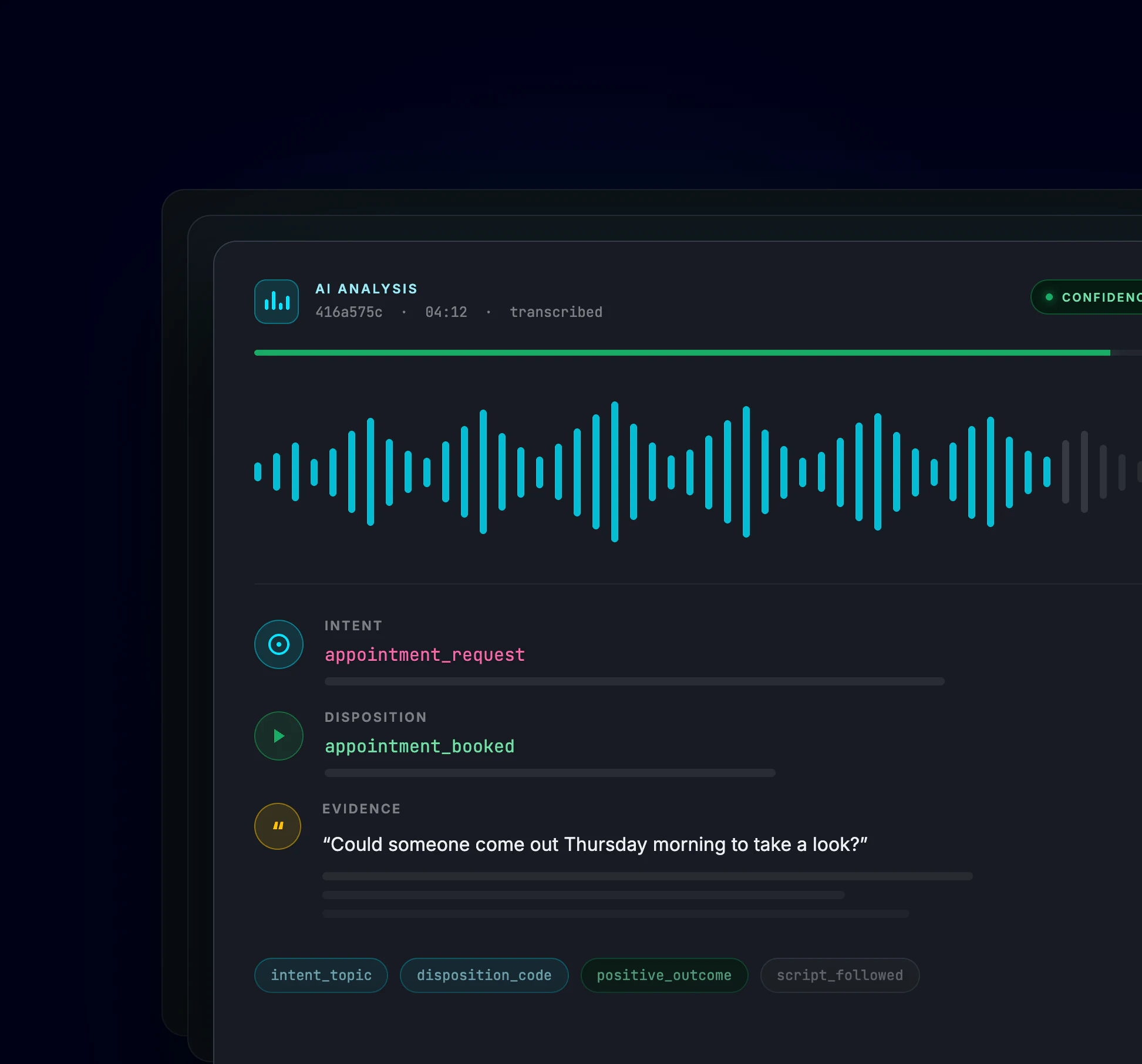
Every call transcribed automatically. Every answer ready to read.
What is the AI Call Analyst?
The AI Call Analyst takes the heavy lifting out of managing your conversations. Instead of spending hours listening back to recordings and typing up notes by hand, you get a digital assistant that transcribes every call automatically, analyzes what was said, and tells you what happened on each one.
Every analyzed call comes back with the caller's intent (what they actually wanted) and the call's disposition (how it ended). Both are backed by evidence quoted directly from the transcript, so you can trust the answer without replaying the audio.
You can also prompt it yourself. Ask questions like "What was the customer's biggest concern?" or "Did the agent follow the script?" and get an answer on every call the analyst touches.
Automatic transcription on every call
Transcription is the foundation of everything else. Turn the analyst on and every call it touches is transcribed automatically, with no uploads, no third-party speech service to wire up, and no one on your team pressing play. The full text lands on the call record alongside the recording, ready to read, search, and report on.
You stay in control of how much gets transcribed. Choose the full call, the first few minutes, or the last few minutes, and let volume caps and filters decide which calls qualify. Everything the analyst tells you afterward is drawn from that transcript, so you can always trace an answer back to the words that produced it.

Automatic Transcription
Every call the analyst touches is transcribed automatically: the full call, or just the first or last minutes you choose.

Intent Analysis
See what the caller wanted, whether that's a quote, an appointment, or support, with evidence pulled straight from the transcript.

Disposition Analysis
Know how every call ended: appointment booked, sale completed, early hangup, or a transfer that never happened.
What the analyst tells you about every call
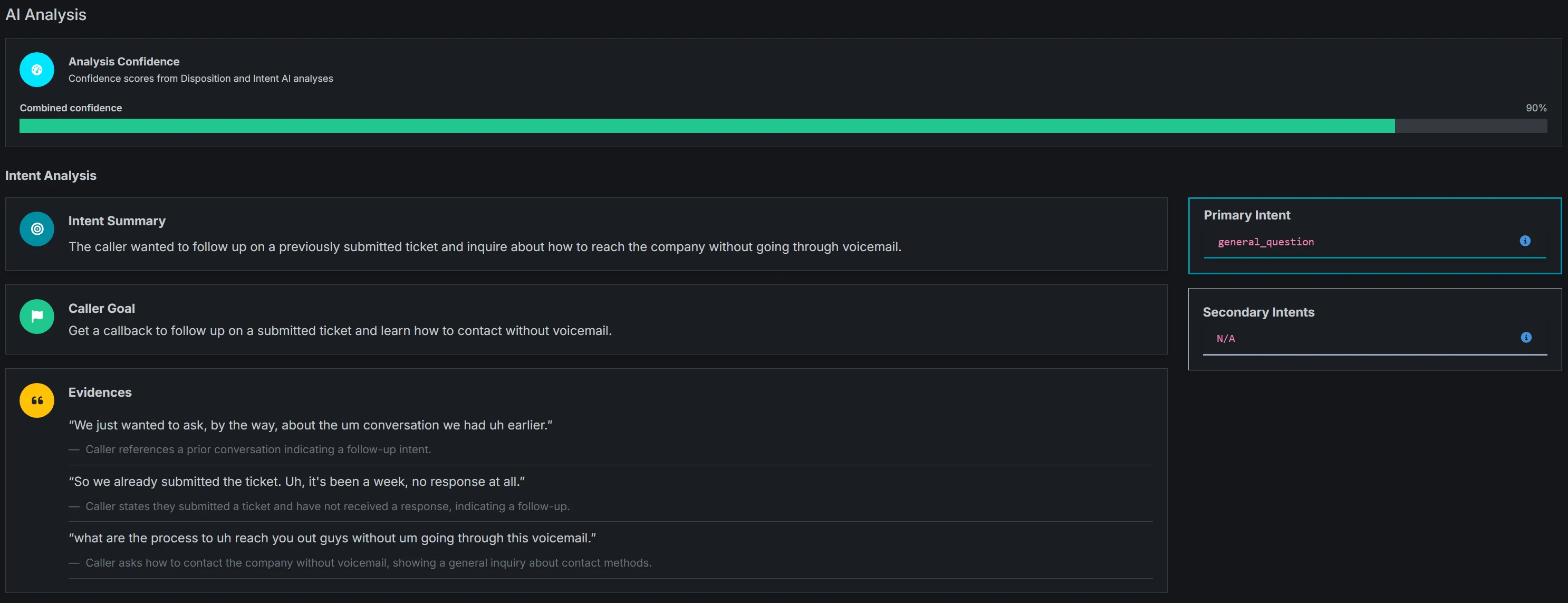
Intent: what the caller wanted
The analyst detects each caller's primary intent, whether that's a product or service inquiry, an appointment request, a support question, or a quote request, then summarizes it in a sentence you can scan in your call log.
Every intent comes with supporting evidence pulled directly from the transcript, so you can see exactly which part of the conversation the answer came from rather than taking the label on faith.
Disposition: how the call ended
Disposition analysis determines the outcome of the call: an appointment booked, a qualified lead, a completed sale, a positive outcome, a hangup or early termination, or whether a transfer was attempted at all.
Tagging outcomes this way lets you measure performance on results instead of call volume and duration. A long call that ended in a hangup and a short call that booked an appointment stop looking the same in your reports.
Custom prompts: your own questions
Beyond intent and disposition, you can add your own questions and have them answered on every analyzed call. Teams commonly ask whether the agent followed the required script, whether the caller sounded frustrated, whether the caller confirmed eligibility, or whether an appointment was actually scheduled.
Custom prompts run on one-off analysis and on automatic campaign, publisher, buyer, and buyer group analysis alike. Their answers are written to the call as tags, which means anything you ask becomes something you can filter and report on.
New to Retreaver Call Tracking?
 Get Started
Launch Your First
Campaign
Create an account and start your first campaign today! Follow our guide on "How to create your first call tracking campaign".
Learn About Call Tracking:
Tracking Tips

Automate it everywhere, or run it on demand
Analyze selected calls on demand
Open your Call Log, filter down to the calls you care about (receivable calls only, for instance), then click AI Analyst, choose how much of each call to transcribe, and analyze. It's the fastest way to run an audit, sample calls for QA, or try the analyst out before turning on automatic analysis.
Or enable it where your calls come from
Enable the analyst on a campaign and every call routed through it can be analyzed automatically, hands-free. It can also be scoped to a single publisher to measure a traffic source, to a buyer to see what's happening on calls you're selling, or to a buyer group to compare a set of buyers against each other.
That makes lead quality comparable across partners on the same terms: not on gut feel or call duration, but on what callers asked for and how those calls ended.
Control the volume and the cost
Transcription is the expensive part of analysis, so you decide how much of each call to transcribe: the full call, the first few minutes, or the last few minutes. We recommend transcribing enough to capture both the intent and the outcome, often around 15 minutes or more, since the analysis is only as good as what it can hear.
Volume caps limit how many calls get analyzed per hour, per day, or per month, so you can sample traffic rather than analyze all of it. Filters narrow the scope further: analyze only receivable calls, only completed calls, or only calls carrying specific tags.
Campaign-level automation
Publisher & buyer scoping
Analysis filters
Volume caps
Automatic transcription
One-off analysis
Results land right in your call log
Review a call without listening to it
Once a call is transcribed and analyzed, it carries the full transcript, a confidence score, an intent analysis section, and a disposition analysis section. Reviewing what happened becomes reading rather than listening, which is the difference between auditing a handful of calls a week and auditing all of them.
Turn your call log into an intelligence dashboard
The analyst writes structured tags onto each call for the intent topic, the disposition code, and a positive-outcome flag, alongside the answers to any custom prompts you configured. Because these are ordinary Retreaver tags, everything you already do with tags works on them.
Show only the calls where an appointment was set. Pull every negative outcome that needs a human review. Compare intent types across campaigns to see which messaging attracts which callers. Identify the publisher whose traffic sounds fine on paper but never converts.
Trigger workflows when analysis finishes
Analysis completes after the call does, so a normal end-of-call webhook would fire too early to include it. The After AI Analysis webhook trigger solves that: it fires once a call's analysis is finished, which is the right moment to push enriched results into a CRM, alert a Slack channel, or kick off follow-up automation.
Replacement tokens give you the analysis in the payload: the disposition summary, stage reached, disposition code, loss reason, termination reason, and transfer outcome, plus the intent's primary topic and summary. Any custom prompt tag can be used the same way.
Built for high-stakes calls
 Medicare & Insurance
Detect enrollment and appointment outcomes, monitor compliance scripts with custom prompts like "Did the agent follow the required Medicare script?", and flag negative outcomes without manual QA.
Home Services
Track booked jobs versus missed calls, surface high-intent quote requests with prompts like "Did the caller request same-day availability?", and compare close rates across traffic sources.
Pay Per Call Networks
Score publisher traffic on real outcomes instead of raw duration. Filter by AI tags to find low-quality sources and negative dispositions before they reach your buyers.
AI Call Analyst FAQs